Self-Organizing Maps
This study investigates the application of a machine learning technique called a Self-Organizing Map (SOM) to the optimal allocation of architectural functions in buildings through volumetric clustering based on daylight requirements.
A Self-Organizing Map is an unsupervised learning technique commonly used to visualize data through a lower-dimensional representation, such as a 2D map. Dimensionality reduction is useful when the input data have many dimensions, making visualization difficult. Like a Neural Network (NN), a SOM consists of nodes (neurons) and associated weight vectors. Nodes can be arranged as needed for the representation, for example, as a rectangular grid of points. Each node is associated with a weight vector having the same dimensionality as the data in the input space. A SOM operates through training and mapping. Training generates a low-dimensional map of the input data and is based on competitive learning. When a training sample is fed into the network, the distance between the input vector and every weight vector is computed to identify the node whose weight vector is closest to the input, i.e., the best matching unit (BMU). At each iteration, one BMU has a specified radius of influence (neighborhood). A Mexican-hat function is typically used to compute changes in the weight vectors based on their distance from the BMU. The weight vectors of the nodes closest to the BMU are adjusted toward the input vector. As the distance from the BMU increases, the magnitude of the adjustment decreases until it becomes negative (inhibitory feedback). For nodes outside the BMU neighborhood, the weight vectors are therefore adjusted away from the input vector. The magnitude of the weight adjustments across the network decreases over time (iterations). This process is repeated for each input vector. The map converges by distributing the features (weights) of the input data into clusters. In other words, observations in the input data set are grouped into clusters of similar values, producing a semantic map that can facilitate understanding of the data set’s structure. A new input can then be classified by identifying the node whose weight vector is closest to it.
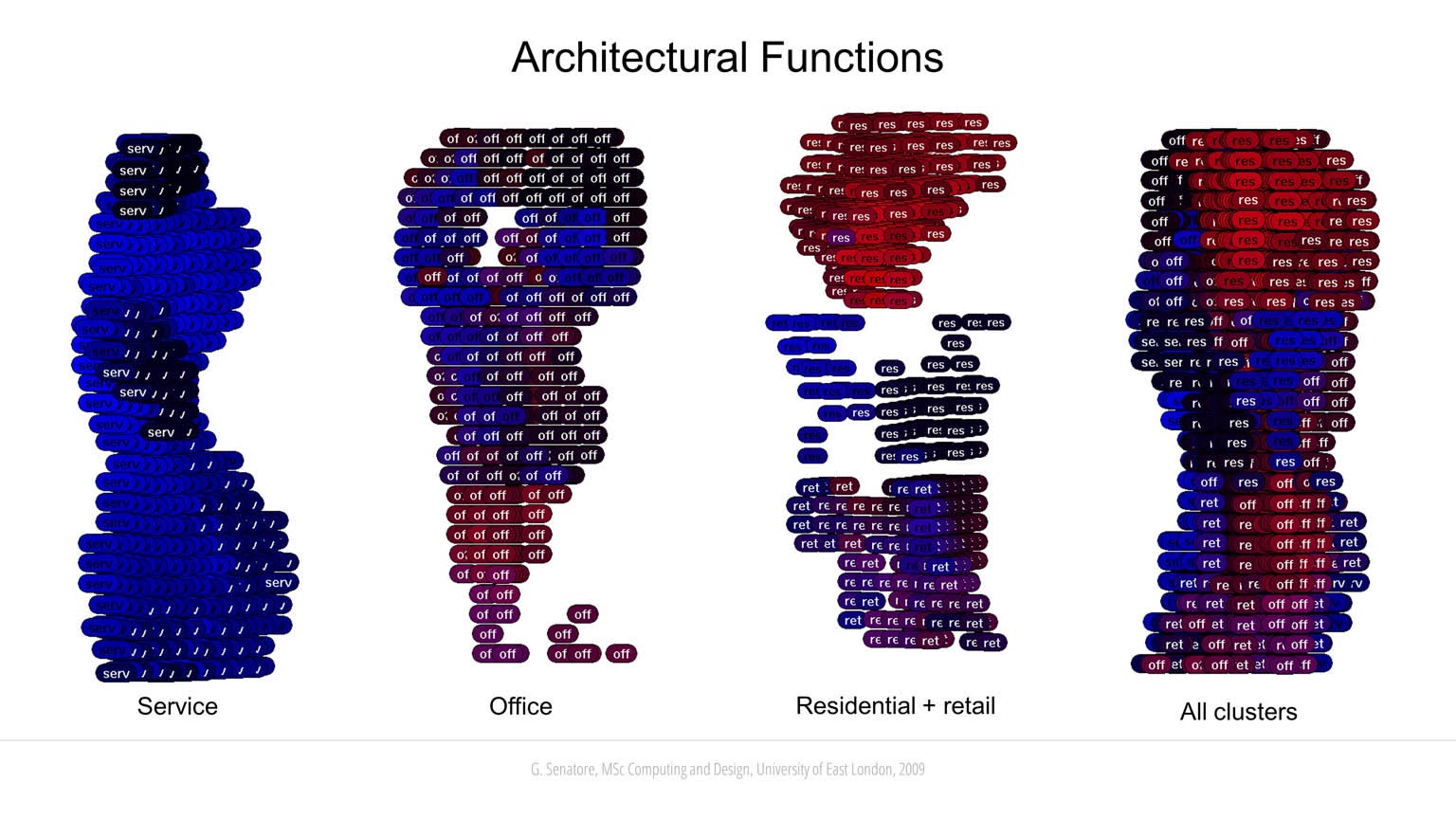
The input vector can represent any data type, including geometric objects, as long as a distance measure can be defined and associated with the weight vector. In this work, the input data consist of a solar radiation map computed on a building envelope through daylight analysis; see one of the examples shown in Evolutionary Computation. The building envelope is represented by a mesh comprising faces and vertices. The network consists of a 3D grid of nodes that approximately fills the internal volume of the envelope mesh. The input space consists of three-dimensional vectors that encode, through RGB color values, the solar radiation associated with the neighboring faces of each mesh vertex. The SOM is trained to subdivide the volumetric space (the map space) based on the input space (the solar radiation map). To map the input vectors into clusters associated with an architectural program, the input space is divided into four subspaces: 1) residential, 2) office, 3) retail, and 4) service. These functions are assigned according to their daylight requirements. The initial value of the weight vectors is RGB(0,0,0). A constraint on the retail function prevents allocation above a specified height. A common feature among the solutions obtained through training is the location of the residential cluster at upper levels and on the south-facing side of the building, while the service cluster is typically located on the north-facing side. Function allocation results from a negotiation between the network’s ability to cluster the input features (the solar-gain map) and the constraints imposed by the architectural program.
Acknowledgments
Gennaro Senatore carried out this research for his Master of Science in “Computing and Design” at the University of East London.
Team
Research Lead:
Gennaro Senatore
Advisors:
Paul Coates, Christian Derix | University of East London