Cellular Automata
This research investigates the application of Cellular Automata to the conceptual design of structures.
Cellular Automata (CA) are discrete computational systems composed of cells whose states depend on their own previous states and those of their neighbors. CA produce complex behavior through simple rules that interconnect the states of the cells. CA are usually implemented on a grid in one, two, or three dimensions. Each cell interacts with a neighborhood comprising a finite number of other cells. The interaction rules are applied to each cell and propagate across the grid through local interactions between neighbors. First developed by Stanislaw Ulam and John von Neumann in the 1940s, CA were subsequently investigated by many researchers; John Conway developed the well-known Game of Life.
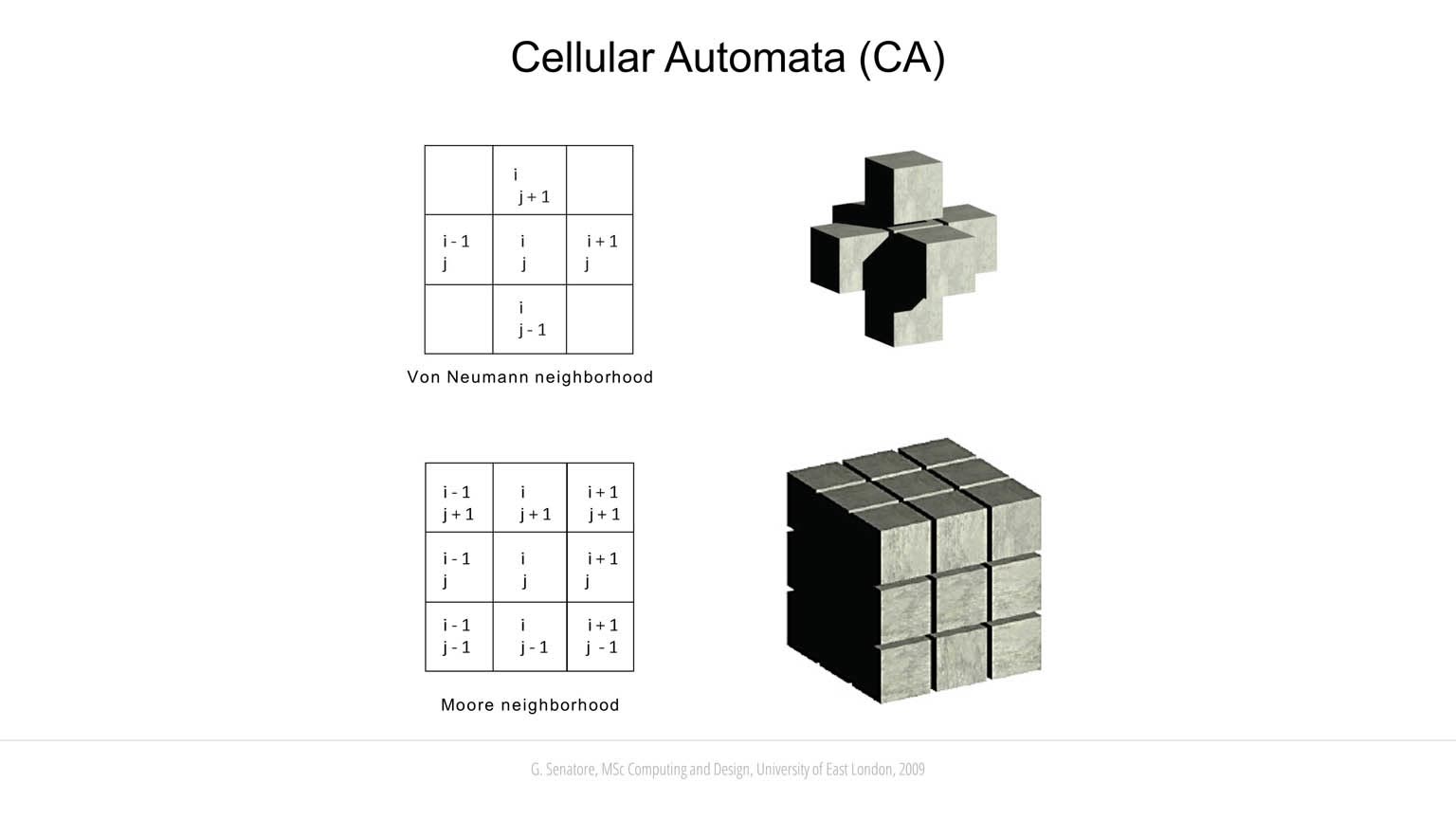
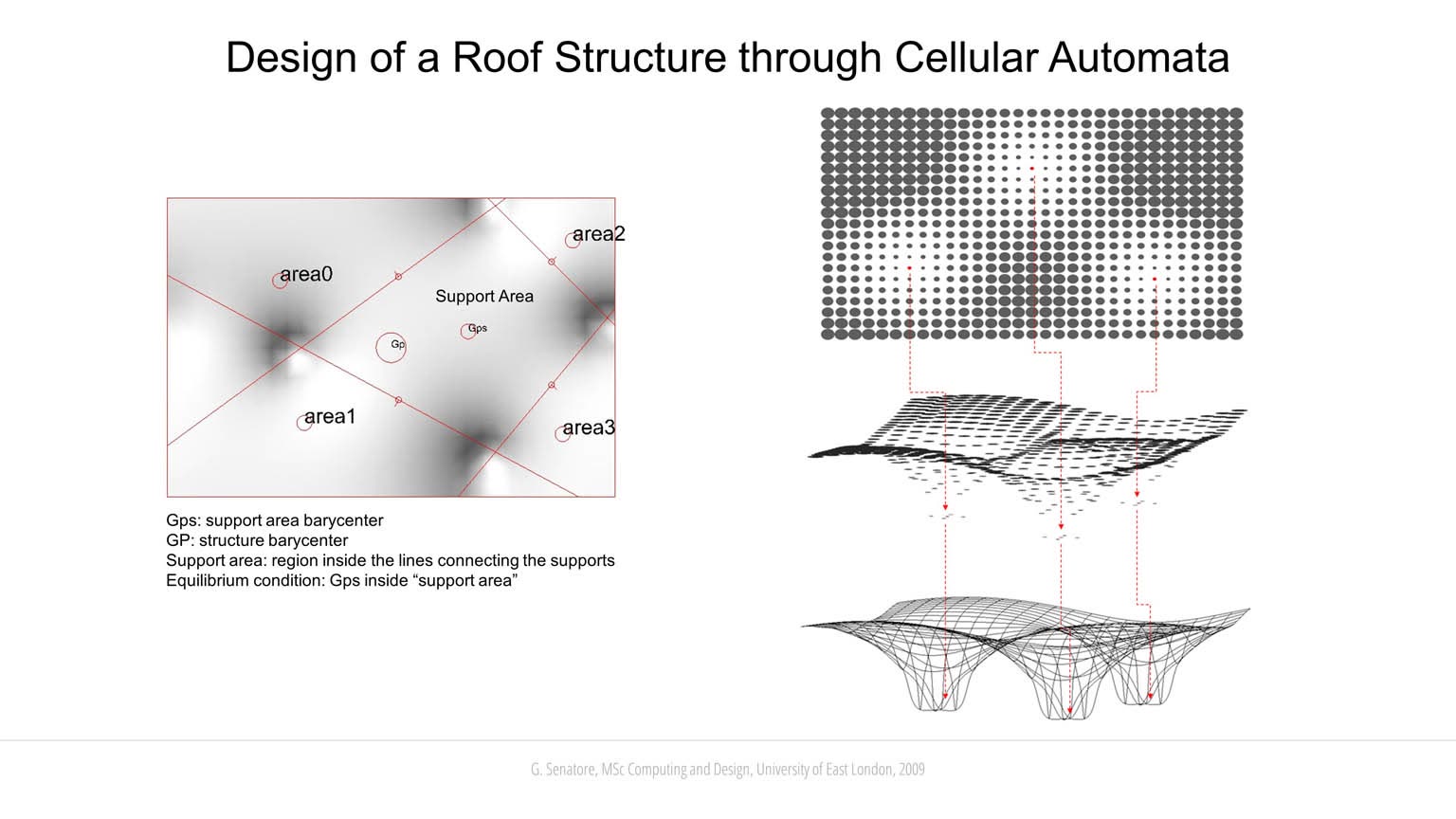
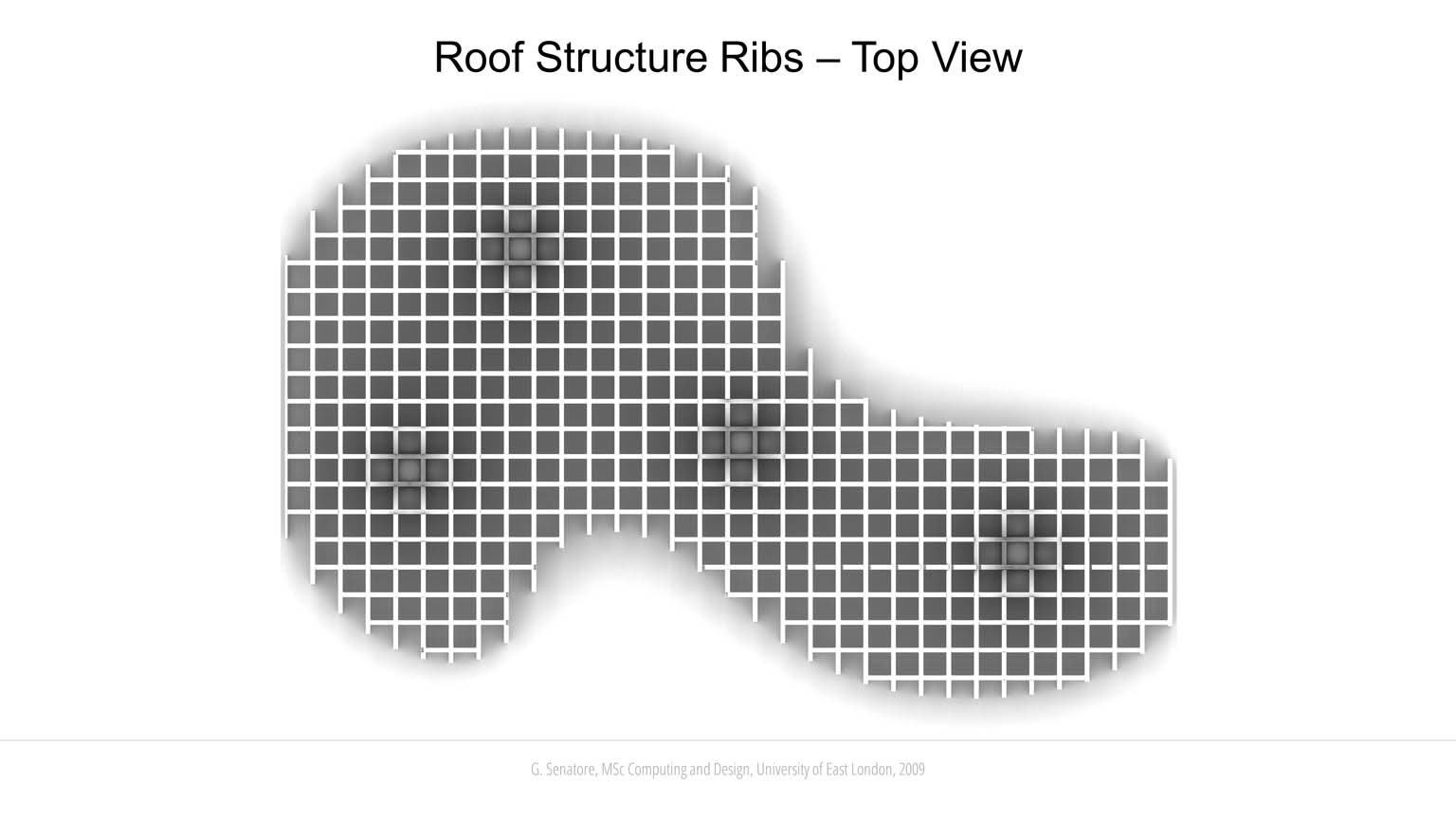
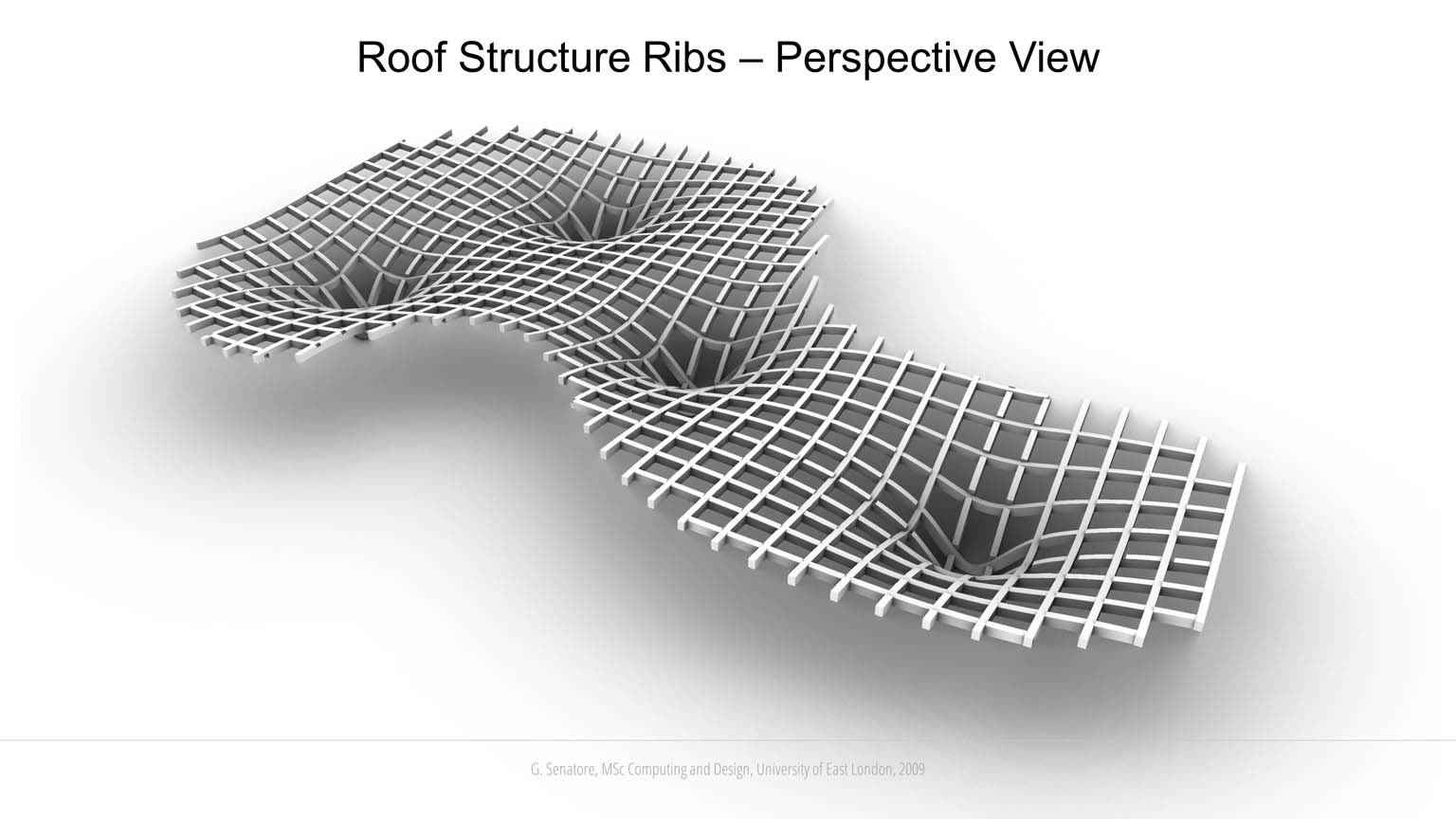
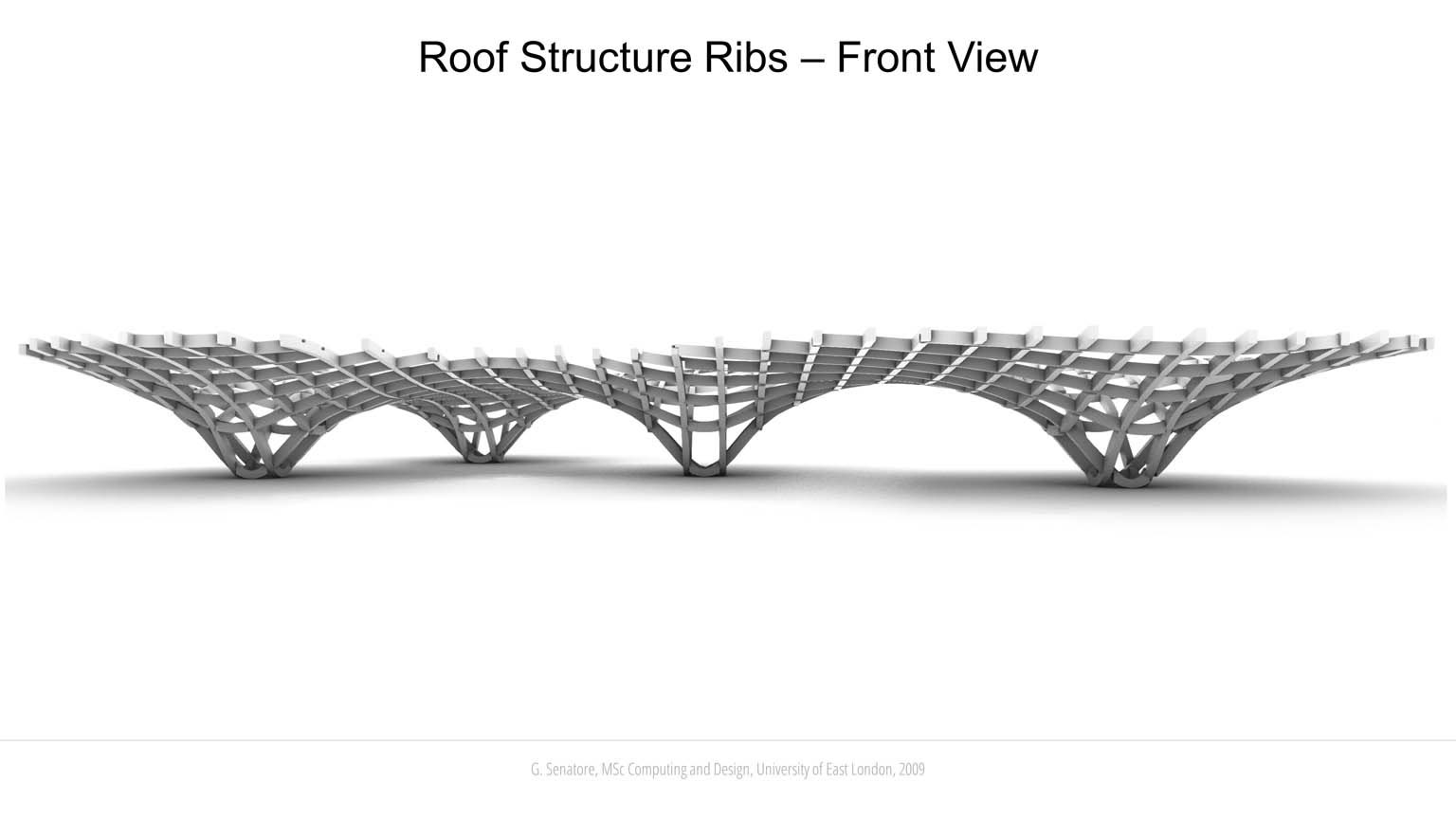
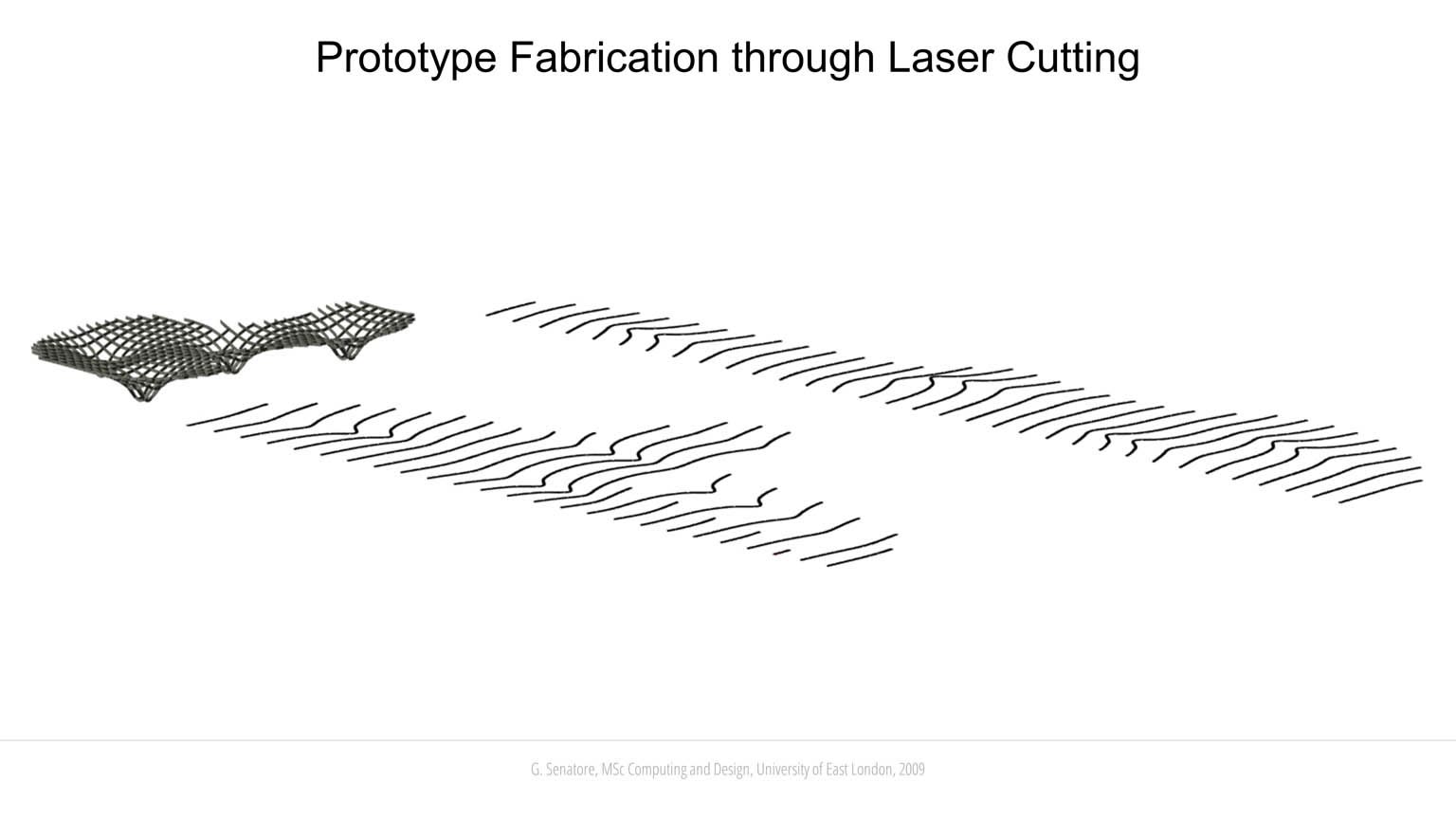
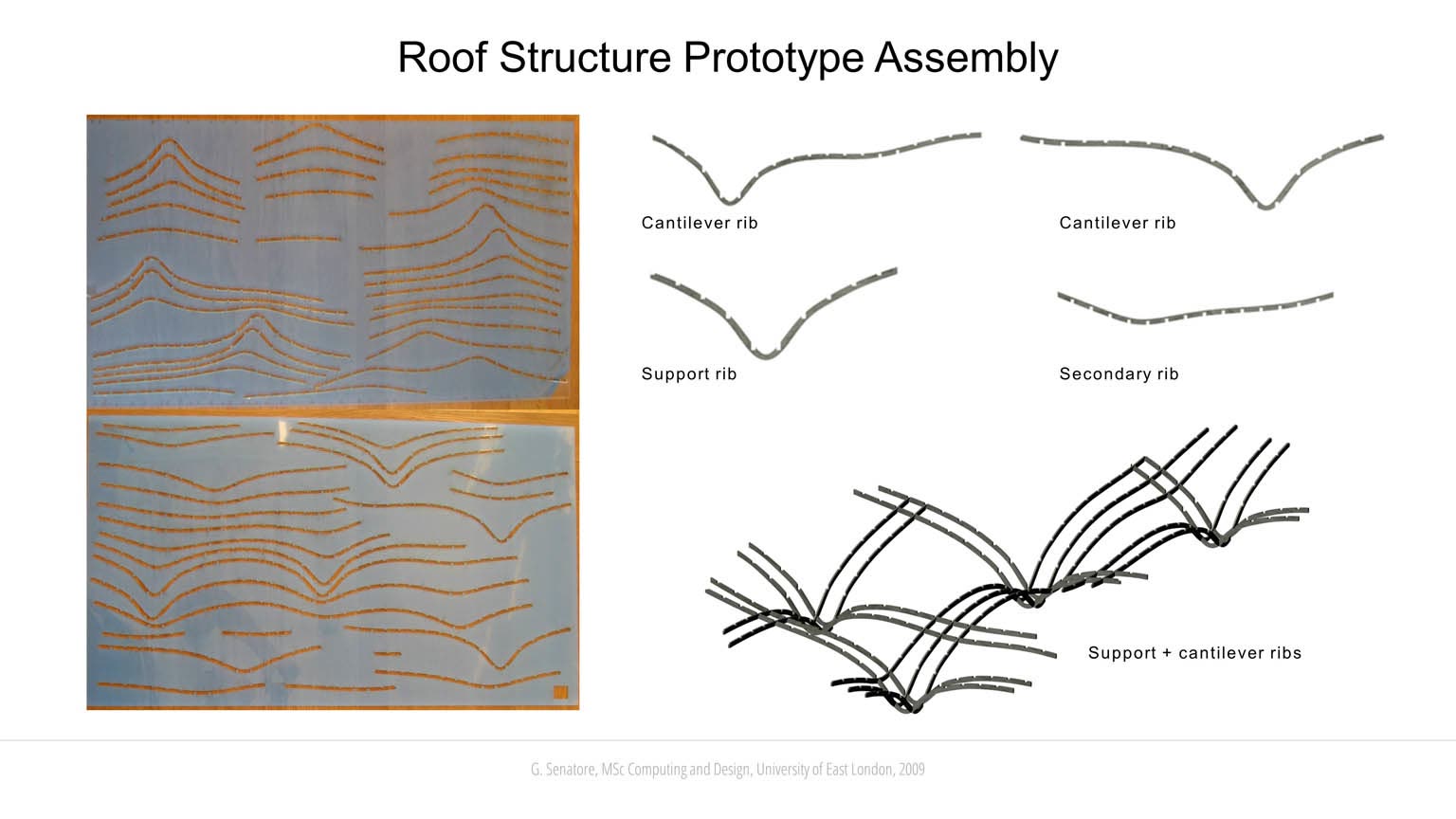
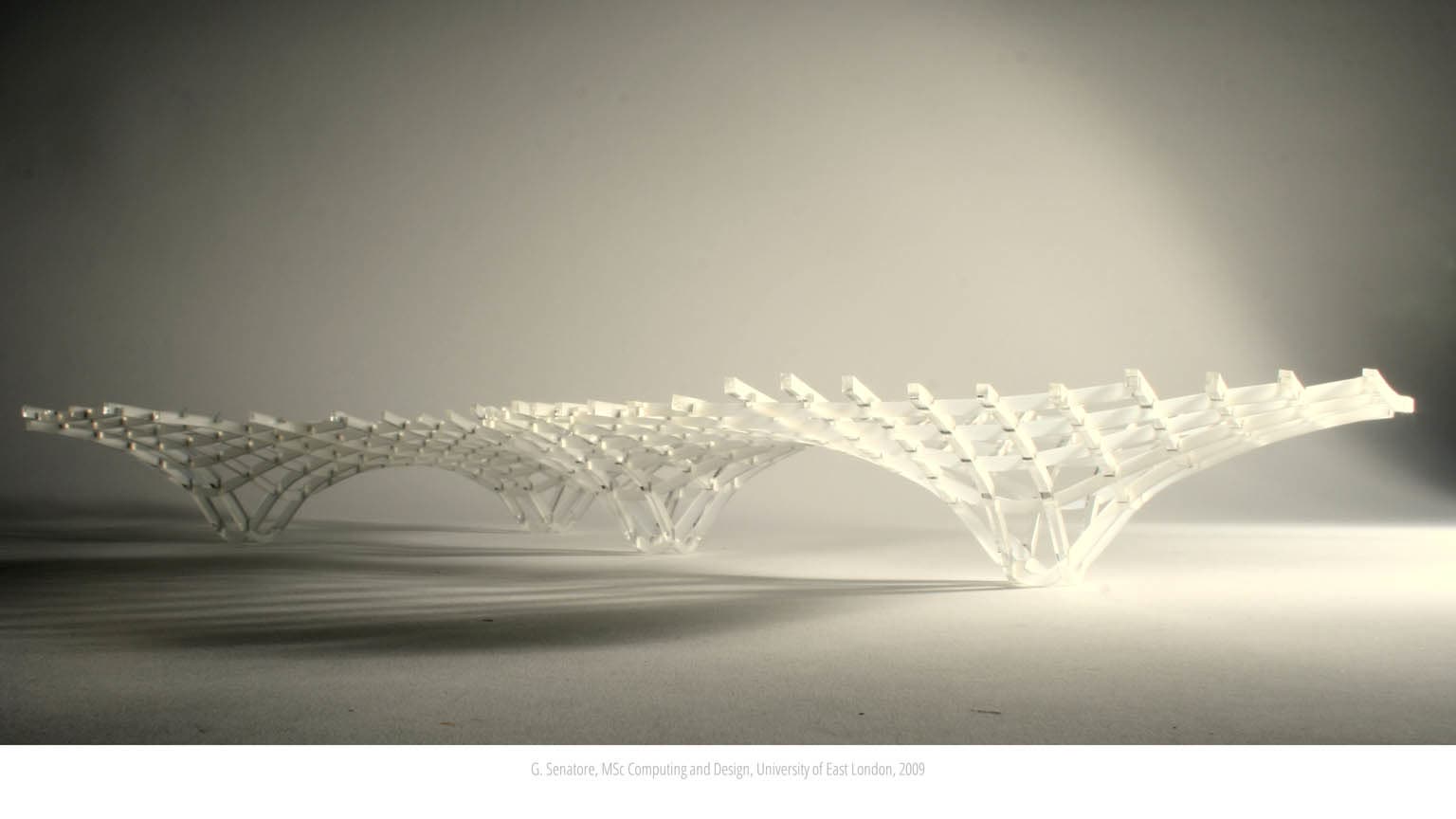
In a 2D application carried out in this work, each cell is surrounded by eight other cells. The CA system is represented as a grid of nodes connected by edges. The intention is to generate a free-form structural grid by specifying the positions of the supports and/or the points of maximum elevation. Basic rules are applied to the grid points to average their vertical positions according to given external inputs. The input nodes are moved away from their initial positions toward their target positions (e.g., support locations). This information propagates through the grid. Each node iteratively moves to a new position, defined by the average of its neighbors’ coordinates, until the input nodes reach their target positions. The result is a free-form grid whose shape depends on the choice of input nodes. The grid is formed by interpolating the node positions with splines that follow its two principal directions (u, v). A separate algorithm takes the splines as input and produces ribs that interlock through a series of grooves. Ribs are classified into three types: support, cantilever, and secondary. Support ribs meet the ground at two or more points, cantilever ribs at one point, and secondary ribs at none. The grooves cut into support ribs are oriented to support all other ribs that interlock with them. The grooves cut into cantilever ribs are oriented to support secondary ribs and change orientation when they interlock with a support rib. A physical model was successfully fabricated by laser cutting the ribs from an 8 mm-thick acrylic sheet.
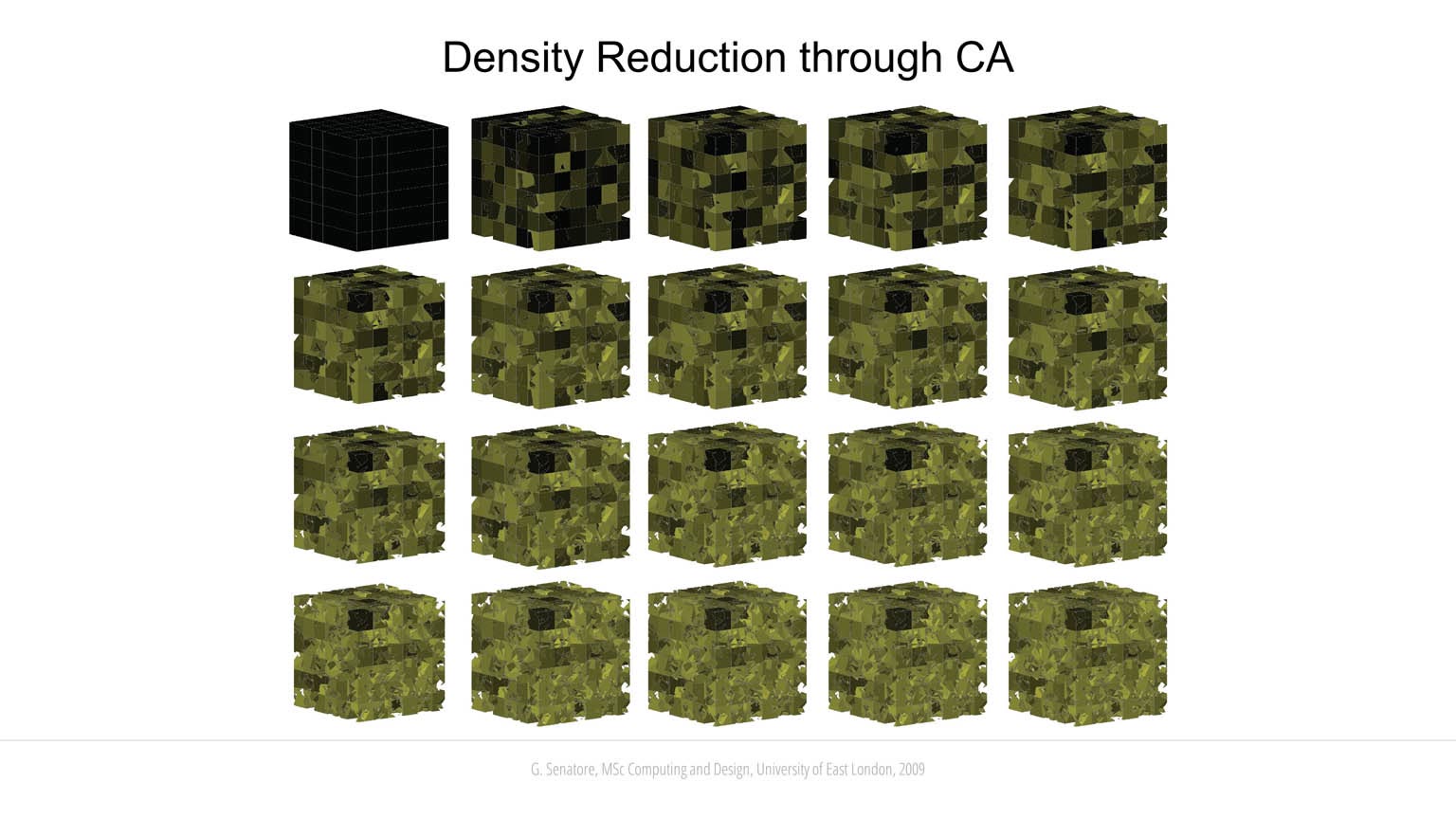
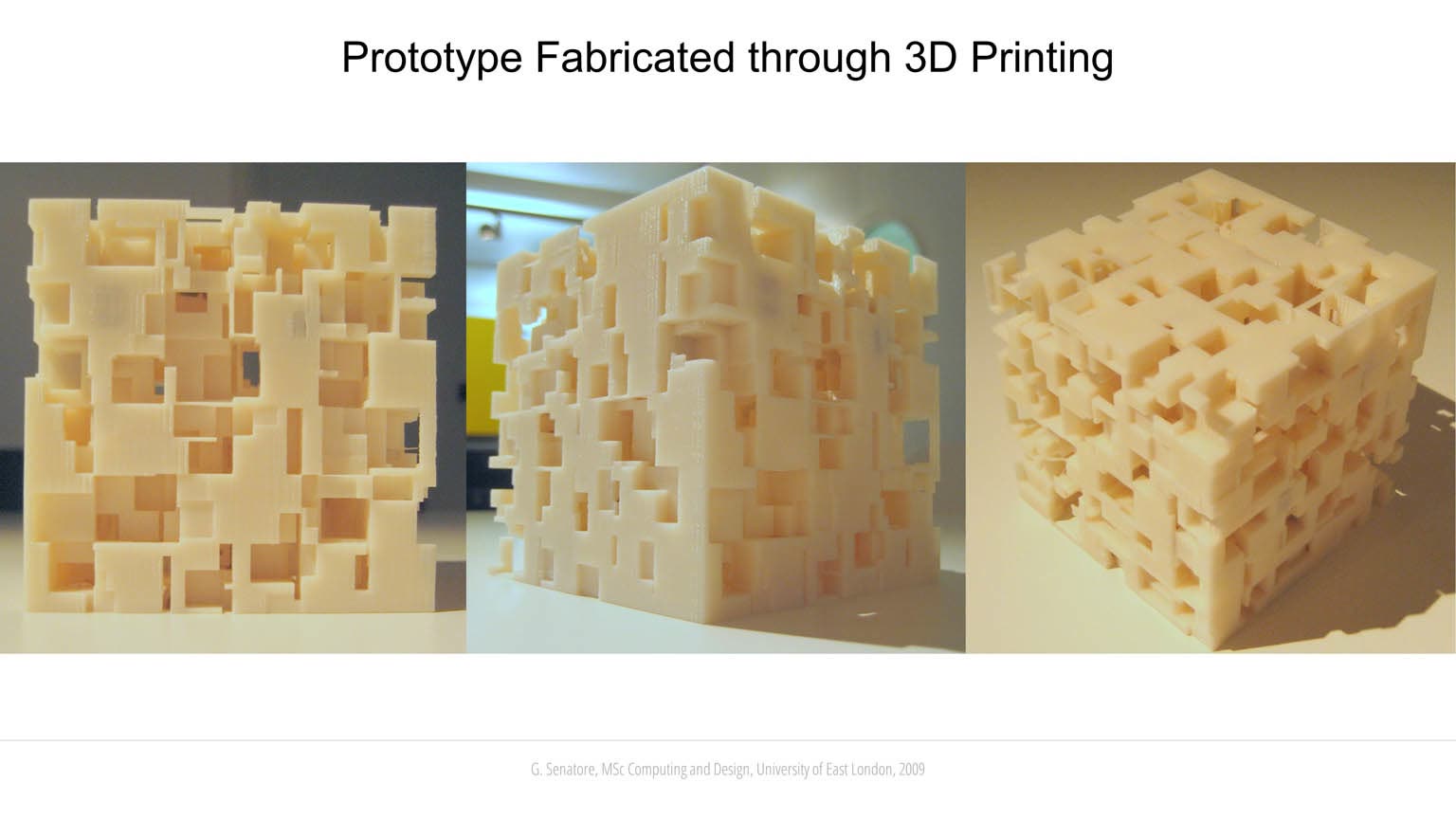
In a 3D application carried out in this work, the cell neighborhood is extended to the other 26 cells in a Moore neighborhood. The CA system is represented as a 3D grid of cubical cells. This application creates a complex 3D artifact by varying the density of the cells. For each cell, the average volume of its neighbors is computed. A cube with this average volume is then created and positioned randomly within a specified radius of the cell centroid. The cube is subtracted from all cells it intersects, thereby generating voids in different locations throughout the 3D grid. Cell color varies according to density: cells with more void space are rendered in a lighter color. The process is repeated for each cell until a target volume is reached. A physical model was successfully fabricated through fused deposition modeling.
Acknowledgments
Gennaro Senatore carried out this research for his Master of Science in “Computing and Design” at the University of East London.
Team
Research Lead:
Gennaro Senatore
Advisors:
Paul Coates, Christian Derix | University of East London